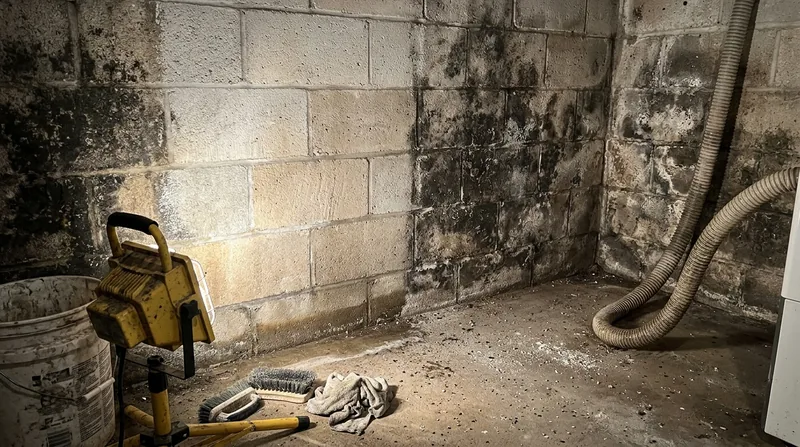




Basement Mold Remediation in Flint: Fix the Moisture, Not Just the Mold
Flint sits on lake-plain clay and glacial till, and the low streets near the Flint River and Thread Creek carry a high water table that pushes moisture through stone, brick and early block walls in Carriage Town, Civic Park and Floral Park. When that water meets a cold basement wall, mold follows. Basement Mold Remediation in Flint is not a scrubbing job. It is a moisture-control job. We treat the affected surfaces, contain the area, and then fix the drainage or humidity problem that let mold grow in the first place. If your basement smells musty after spring snowmelt, or you see dark staining on the lower block courses in a Mott Park ranch, call us at (810) 213-2409. We start with the source. See how we approach the full basement waterproofing picture before we touch a surface.
Why Basement Mold Grows So Fast in Flint's Older Basements
Most Flint basements were built before modern dampproofing, and many have stone or brick walls with no footing drain worth the name. Water moves through the wall by capillary action, hits the cool interior face, and condenses. Add a humid summer and a partly finished basement in Woodcroft, and you have ideal conditions for mold on joists, drywall and stored goods. The problem is rarely the mold itself. It is the hydrostatic pressure and the high water table feeding it.
- Stone and brick walls in 1900s-1930s homes wick groundwater and stay damp for weeks after a rain.
- Poured basements in 1970s-1990s Burton and Grand Blanc splits collect condensation on cold wall faces when humidity climbs.
- Old coal bins and bulkhead doors in Floral Park bungalows leak at the frame and feed mold in the corner.
- Failed sump pumps leave standing water that soaks drywall and framing within a day.
- Spring snowmelt drives water through the floor joint, and that moisture has nowhere to go without drainage.
Treating the mold without correcting the moisture source means it returns with the next wet season. That is why we diagnose first and remediate second.
Key info: A 1920s foursquare in Civic Park with a stone foundation and no interior drain will grow mold on the lower wall every humid summer until the wall is sealed and the perimeter is drained. We have seen the same pattern in Flushing and Montrose.
For official guidance on moisture and mold in buildings, the U.S. EPA maintains a plain-language resource at epa.gov/mold. For local permit questions on drainage alterations, confirm with the City of Flint building department before work begins.
How We Run Basement Mold Remediation in Flint, Step by Step
We do not fog a basement and call it done. Our process starts with a musty-smell diagnostic and a moisture reading on the walls, floor joint and framing. Then we contain the work area, remove or treat affected materials, and correct the moisture path. The order matters: remediation without a moisture fix is a callback waiting to happen.
- We inspect the basement and identify the moisture source: wall seepage, floor joint, sump failure or humidity.
- We set up containment and negative air so spores do not spread to the rest of the house.
- We remove porous materials that cannot be cleaned and treat structural surfaces with an antimicrobial.
- We correct the source with crack injection, wall sealing, interior drain tile or a sump upgrade as needed.
- We verify dryness with a moisture meter and leave a written summary of what was done.
Every step is documented so you know what was treated and what was fixed.
Key info: A split-level in Swartz Creek had mold on the lower drywall after a sump failure. We removed the affected board, treated the plate, replaced the pump and added a battery backup. The moisture reading told us the wall was dry before we closed it up.
When the source is a wet wall rather than a crack, the answer is often an interior drain tile system that captures water at the footing and routes it to the sump.
Remediation Approaches We Use in Flint Basements
The right approach depends on what is growing and why. A surface film on a block wall is a different job from mold behind finished drywall. We match the method to the moisture source and the building material.
| Approach | Description | Best for |
|---|---|---|
| Surface treatment and cleaning | HEPA vacuum, antimicrobial wash and seal on structural surfaces | Light mold on block or brick walls with a known seepage source |
| Containment and removal | Negative air, poly containment and removal of porous materials | Mold behind finished drywall or on joists after a flood |
| Moisture source correction | Crack injection, wall sealing, drain tile or sump upgrade | Recurring mold tied to wall seepage or a failed pump |
| Humidity control | Dehumidification and ventilation to hold basement RH in range | Condensation mold in tight, partly finished basements |
Most Flint jobs combine two of these. We tell you which ones you actually need.
Basement Mold Remediation Cost in Flint: What to Expect
Pricing starts at From $1,500 for a contained remediation with surface treatment and a moisture-source correction. The final number depends on square footage affected, how much porous material has to come out, and whether the fix is a simple crack injection or a full perimeter drain. A single wall in a Davison ranch is not the same job as a finished basement in Grand Blanc.
We quote after we inspect, not over the phone. Two or three estimates is smart on any job over a thousand dollars, and any contractor who will not put the scope in writing is telling you something. Our full breakdown is on the pricing page.
Key info: A Fenton basement with mold on two walls and a failed sump ran higher than a Clio job with a single damp corner. The difference was the drainage work, not the square footage.
Hiring a Basement Mold Remediation Contractor Near Me in Flint
Ask three questions before you sign: are you licensed and insured, what is the moisture source, and what happens if the mold comes back. A contractor who only talks about killing mold and never mentions drainage or humidity is selling you a repeat visit. Get references from Flint-area homeowners with the same foundation type as yours.
Permits vary by jurisdiction for work that alters drainage or the sanitary connection of a sump discharge. Confirm with the local building department before work starts. We pull what is required and tell you what to expect. Reach us through the contact page or call (810) 213-2409.
Basement Mold Remediation in Flint: Pricing Guide
| Service | Price | Details |
|---|---|---|
| Contained surface remediation | Starting at $1,500 | Includes containment, HEPA vacuuming, antimicrobial treatment and a moisture reading on affected walls. |
| Remediation plus crack injection | Starting at $1,900 | Adds epoxy or polyurethane injection at the seepage point driving the mold growth. |
| Remediation plus interior drain tile | On estimate | For recurring mold tied to hydrostatic pressure at the floor joint, scoped after inspection. |
| Sump failure cleanup and pump replacement | On estimate | Depends on water volume, affected materials and whether a battery backup is added. |
| Travel | Included | In Flint and surrounding areas, no separate call-out or mileage fee. |
| Estimate | Free | Response within 24h at (810) 213-2409, no obligation to book. |
Indicative pricing, the exact cost depends on square footage, finish, and site access. Free personalized estimate within 24h at (810) 213-2409.


