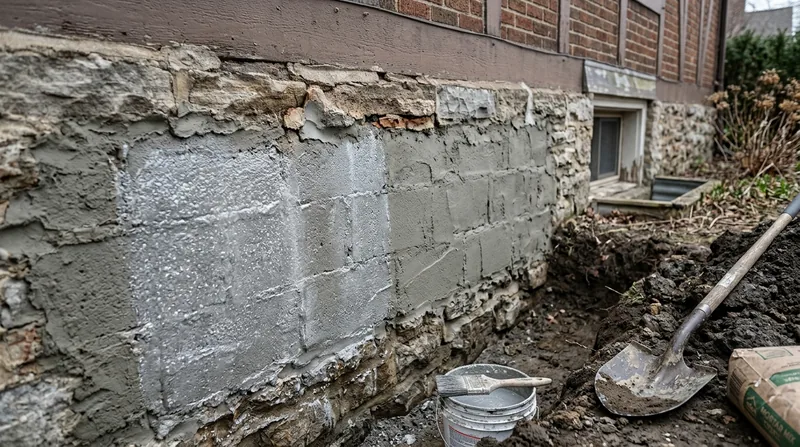




Foundation waterproofing in Flint starts with the ground under your house, not a bucket of sealer. Most of this city sits on glacial clay and till over sand lenses, so water moves slowly through the soil and pushes hard against basement walls. In Carriage Town and Civic Park, that pressure works on fieldstone and brick walls laid before 1930. Out in Burton, Grand Blanc and Swartz Creek, poured 1970s and 1990s walls meet the same wet clay on sloped lots. When the Flint River and Thread Creek run high in spring, the water table lifts and the floor joint weeps. We read the wall, the soil and the drainage before we quote anything. Start with a basement waterproofing walkthrough so we can tell you whether you need crack injection, drainage, or both.
Why Flint Foundations Leak: Clay Soil, Frost and Old Walls
Flint winters drive deep frost into the ground, and the freeze-thaw cycle opens hairline cracks in older block and brick walls. Spring snowmelt then finds those cracks, and the clay holds the water against the foundation instead of letting it drain away. Homes near the river bottoms and low streets around Thread Creek see the water table rise close to the footing. That is hydrostatic pressure, and no coating on the inside face will stop it.
- Fieldstone and early block walls in Carriage Town and Floral Park absorb water and show efflorescence as white salt bloom on the face.
- Brick ranches in Mott Park and Woodcroft often have a settled floor joint that lets water in along the perimeter.
- Poured walls in Burton and Grand Blanc crack at the shrinkage line and seep at the tie holes.
- Old coal bins and bulkhead doors in 1920s bungalows create cold pockets where condensation and seepage both show up.
Each of these failure modes calls for a different repair, and guessing wrong wastes money.
Key info: A 1928 foursquare in Civic Park with a stone wall and a wet floor joint usually needs interior drainage and parging, not exterior excavation. A 1985 colonial in Swartz Creek with a single vertical crack usually needs epoxy or polyurethane injection and nothing more.
For official guidance on structural repair permits in the city, check the City of Flint building department before any work begins.
How We Waterproof a Flint Foundation, Step by Step
We start by walking the basement and the yard together, because the leak inside is usually caused by something outside. We check grading, downspout extensions, window wells and the visible crack pattern. Then we map where the water is actually coming from before we recommend a method.
- We inspect the wall type, the floor joint, the sump basin and any existing drain tile.
- We probe the exterior grade and confirm whether downspouts dump within three feet of the footing.
- We recommend the least invasive repair that solves the actual problem, whether that is crack injection, wall sealing or a drainage correction.
- We pull the required permit when the scope touches structural repair or alters drainage.
- We complete the work, test it with water where possible, and walk you through what we did.
If the diagnosis points to a wet perimeter rather than a single crack, we move to an interior drain tile system instead of tearing up the yard.
Key info: On a 1955 brick ranch in Mott Park, the downspouts were dumping into a bed of clay six inches from the wall. Extending the discharge lines and regrading the soil solved most of the seepage before we touched the wall.
Waterproofing Methods We Use on Flint Foundations
Not every wet wall needs the same treatment. The table below shows the main approaches we use across Flint and the surrounding suburbs, and what each one is actually good for.
| Approach | Description | Best for |
|---|---|---|
| Epoxy injection | Ports drilled along the crack, resin injected to fill and bond the concrete. | Non-moving poured wall cracks that are not actively leaking. |
| Polyurethane injection | Foam resin injected into wet cracks, expanding to seal active leaks. | Active leaks and cracks that may still move slightly. |
| Parging and wall sealing | Repair coat over stone or block, followed by a breathable sealer. | Pre-1940 stone and brick walls with surface seepage. |
| Exterior membrane and dimple board | Waterproof membrane applied to the outside face, protected by drainage board. | Walls being excavated anyway, or severe exterior-side seepage. |
| Interior perimeter drain | Drain tile at the floor joint feeding a sump basin and pump. | Hydrostatic pressure and wet floor joints that no crack repair fixes. |
We match the method to the wall and the water, not to a sales target.
Foundation Waterproofing Cost in Flint: What to Expect
Most foundation waterproofing in Flint starts around $3,500, and that figure covers the common crack injection and wall sealing jobs on poured and block walls. Stone walls, full perimeter drainage and exterior excavation run higher because they take more labor and more material. The number moves with wall type, linear footage, access to the basement, and whether a permit is required.
- A single poured-wall crack with polyurethane injection is the lowest-cost repair.
- A stone wall that needs parging and sealing costs more because the surface has to be prepped properly.
- Interior perimeter drainage with a new sump basin and pump sits in the middle of the range.
- Exterior excavation and membrane work is the high end, and we only recommend it when the outside face is the real problem.
Get two or three written estimates and compare scope, not just the bottom line. Our full pricing overview breaks down what each job includes.
Foundation Waterproofing Near Me: How to Choose a Contractor Near Flint
Ask three things before you sign anything: are you licensed and insured, what exactly is in the scope, and who pulls the permit. A waterproofing contractor near Flint should be able to explain why they chose one method over another in plain language. If the answer is always the same system, walk away.
- Confirm the license and insurance certificate, and ask for it in writing.
- Get at least two or three estimates on the same scope so you can compare fairly.
- Ask for references from jobs in Flint, Burton or Grand Blanc with similar wall types.
- Check who is responsible for permits when the work touches structural repair or drainage connections.
- Ask about the warranty terms and whether they transfer to a new owner.
When you are ready, contact us and we will schedule a free basement inspection.
When Simple Sealing Is Enough and When It Is Not
Homeowners often ask us to just seal the wall and be done. Sometimes that works. A dry, non-moving crack in a poured wall in Grand Blanc can be injected and sealed in a few hours. But if the wall is bowing, if the floor joint is wet across the whole perimeter, or if water shows up after every heavy rain, sealing alone will fail. That is hydrostatic pressure, and the fix is drainage, not a coating. We tell you plainly which case you are in, even when the smaller job pays us less.
For bowing or cracked walls that have moved, we bring in foundation crack repair methods including carbon fiber straps and wall anchors before any waterproofing goes on.
Foundation Waterproofing in Flint: Pricing Guide
| Service | Price | Details |
|---|---|---|
| Crack injection (single crack) | Starting at $3,500 | Includes port drilling, epoxy or polyurethane injection, and cleanup for one poured-wall crack. |
| Wall sealing and parging | Starting at $4,200 | Includes surface prep, parging on stone or block, and a breathable sealer coat. |
| Interior perimeter drainage | Starting at $6,500 | Includes drain tile at the floor joint, sump basin, pump, and discharge line. |
| Exterior membrane and dimple board | On estimate | Requires excavation and an on-site look at access, wall condition, and depth. |
| Travel | Included | In Flint and surrounding areas, no separate call-out or mileage fee. |
| Estimate | Free | Response within 24h at (810) 213-2409, no obligation to book. |
Indicative pricing, the exact cost depends on square footage, finish, and site access. Free personalized estimate within 24h at (810) 213-2409.


