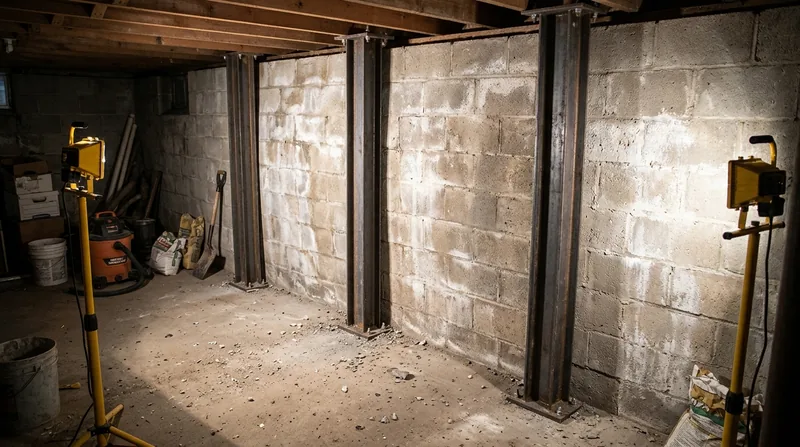




If you own an older home in Flint, you already know the ground here is heavy lake-plain clay and glacial till. That soil holds water against a foundation wall long after the rain stops, and when it freezes and thaws through a Michigan winter, it pushes. Bowing Wall Repair in Flint is the work of stopping that movement before a block wall leans far enough to need replacement. We see it most in the stone and brick basements of Carriage Town and Civic Park bungalows, and in the poured walls of 1970s split-levels out in Burton and Swartz Creek. Flint Waterproofing stabilizes the wall, addresses the pressure behind it, and tells you honestly whether you need straps, anchors, or a full rebuild. Call Flint Waterproofing at (810) 213-2409 to get a free basement inspection and a straight answer.
Why Bowing Walls Are a Flint Problem, Not a Cosmetic One
The Flint metro sits on lake-plain clay over sand lenses, and the water table runs high on the low streets near the Flint River and Thread Creek. Clay does not drain. It swells against the wall in spring, then the deep frost of January and February locks it in place and heaves. Add 1920s brick and early block walls that were never designed for that load, and you get the classic inward bow at mid-wall. Left alone, the wall keeps moving until the floor joists above it start to sag.
- You see horizontal cracks in a block wall, usually near the middle course, which is the first sign of pressure.
- You notice the top of the wall pulling away from the sill plate or the floor joists above it.
- You find doors and windows on the main floor sticking in seasons when they used to close cleanly.
- You spot white efflorescence or damp patches that track along the same line as the bow.
- You can see daylight or feel a draft at the wall-to-floor joint in a finished basement.
Any one of those is worth a look. Two or more together mean the wall is actively moving and should be evaluated this season.
Key info: A foursquare off Floral Park we inspected last spring had a 1.5 inch bow at mid-wall and horizontal cracking on three courses. The homeowner thought it was settling. It was clay pressure from a downspout that had been dumping at the same corner for years.
Structural foundation repair in Michigan is permitted work in most jurisdictions, and the rules vary by city and township. Verify requirements with the City of Flint building department or your local authority before work starts: City of Flint official site.
How We Diagnose and Stabilize a Bowing Wall in Flint
We start by reading the wall, not by selling a system. That means measuring the bow at its deepest point, checking for horizontal cracking and stair-step movement, and probing the soil and drainage on the outside. We also look at what the wall is holding up. A block wall under a full two-story house in Mott Park carries a different load than a single-story ranch wall, and the repair has to match it.
- We map the wall with a string line and a level and record the actual deflection in inches.
- We inspect the exterior grade, downspout discharge, and any old coal bin or bulkhead door that is letting water in.
- We check the footing drain and sump basin to see whether hydrostatic pressure is being relieved at all.
- We match the repair to the movement: carbon fiber straps for a stable wall with a moderate bow, steel I-beams for a wall that needs real vertical stiffness, wall anchors when the pressure is still active and the wall must be pulled back.
- We correct the water source, because a strap on a wet wall is a temporary fix.
- We document the before-and-after deflection so you have a record of what changed.
The order matters. Stabilizing first and draining second leaves the wall fighting the same clay. Draining first and stabilizing second is the sequence that holds.
Key info: On a 1950s brick ranch in Woodcroft, the wall had bowed about an inch and the footing drain was clogged solid with clay. We installed carbon fiber straps on the interior and cleared the drainage path outside, and the wall has held its position through two winters. If we had only strapped it, the pressure would have kept building.
If the bow comes with wet walls and a wet floor, the drainage side of the job belongs with interior drain tile. That is usually the better answer than excavating the whole exterior in this clay.
Repair Methods We Use and When Each One Fits
No single method fits every wall. The right choice depends on how far the wall has moved, whether it is still moving, and what is pressing on it from the outside. Here is how we match the approach to the condition.
| Approach | Description | Best for |
|---|---|---|
| Carbon fiber straps | Epoxy-bonded straps run vertically from sill to footing on the interior face. | Block walls with a moderate bow that has stabilized. |
| Steel I-beams | Vertical steel beams set against the wall and tied into the floor structure. | Walls needing real stiffness or where the bow is more advanced. |
| Wall anchors | Plates on the exterior soil side tied through the wall to interior brackets. | Active pressure where the wall has to be pulled back toward plumb. |
| Drainage correction | Clearing or replacing the footing drain and redirecting downspouts and grade. | Every bow, because the water source has to be relieved. |
| Wall rebuild | Removing and rebuilding a section of wall that has moved too far to stabilize. | Severe movement or crushed block where stabilization will not hold. |
We tell you which of these fits your wall and why. If simple crack sealing is enough, we say so and skip the structural work.
Bowing Wall Repair Cost in Flint: What to Expect
Pricing on a bowing wall starts around $600 for a limited stabilization scope and climbs from there. The number is driven by how far the wall has moved, how many straps or beams the wall needs, and whether the drainage has to be corrected at the same time. A single-wall carbon fiber job on a Burton ranch is a different ticket than a full anchor system on a Civic Park block basement with active pressure.
Access matters too. A finished basement means moving stored items and protecting the floor before we can work the wall. A wall behind a coal bin or a bulkhead door takes longer to reach. And if the footing drain is collapsed, that correction adds to the job because the wall cannot be stabilized against pressure that never stops.
Get two or three estimates and compare scope, not just the bottom line. One contractor may quote straps only, another straps plus drainage, and the difference in what is included explains most of the price gap. Our full breakdown is on the pricing page.
What to Look For in a Bowing Wall Repair Contractor Near Me in Flint
Hiring for structural work is different from hiring for a sump pump. Ask for proof of licensing and insurance before anyone touches the wall, and get the certificate sent to you rather than taking a verbal yes. Ask how many bowing walls the contractor has stabilized in Genesee County and what methods they actually install, not just what they subcontract.
Get at least two or three written estimates that spell out the method, the number of straps or beams, and whether drainage correction is included. Ask for references from jobs at least two winters old, because a wall that held through one freeze-thaw cycle has not really been tested. Confirm who pulls the permit, since structural repair is commonly permitted work and the rules vary by jurisdiction. Then verify the local requirement with your building department.
Reach out through our contact page or call (810) 213-2409 to set up the free inspection.
Bowing Wall Repair in Flint: Pricing Guide
| Service | Price | Details |
|---|---|---|
| Limited stabilization (single wall, minor bow) | Starting at $600 | Covers assessment and a limited strap or beam scope on one accessible wall. |
| Carbon fiber strap system | Starting at $1,800 | Interior straps bonded from sill to footing; price rises with strap count and wall length. |
| Steel I-beam reinforcement | Starting at $3,200 | Vertical steel beams tied into the floor structure; beam count and access drive the total. |
| Wall anchor system | Starting at $4,500 | Exterior plates and interior brackets for active pressure; excavation access is the main variable. |
| Complex or large-scale job | On estimate | Multiple walls, crushed block, or combined drainage correction needs an on-site look first. |
| Estimate and inspection | Free | Response within 24h at (810) 213-2409, no obligation to book the work. |
Indicative pricing, the exact cost depends on square footage, finish, and site access. Free personalized estimate within 24h at (810) 213-2409.


